
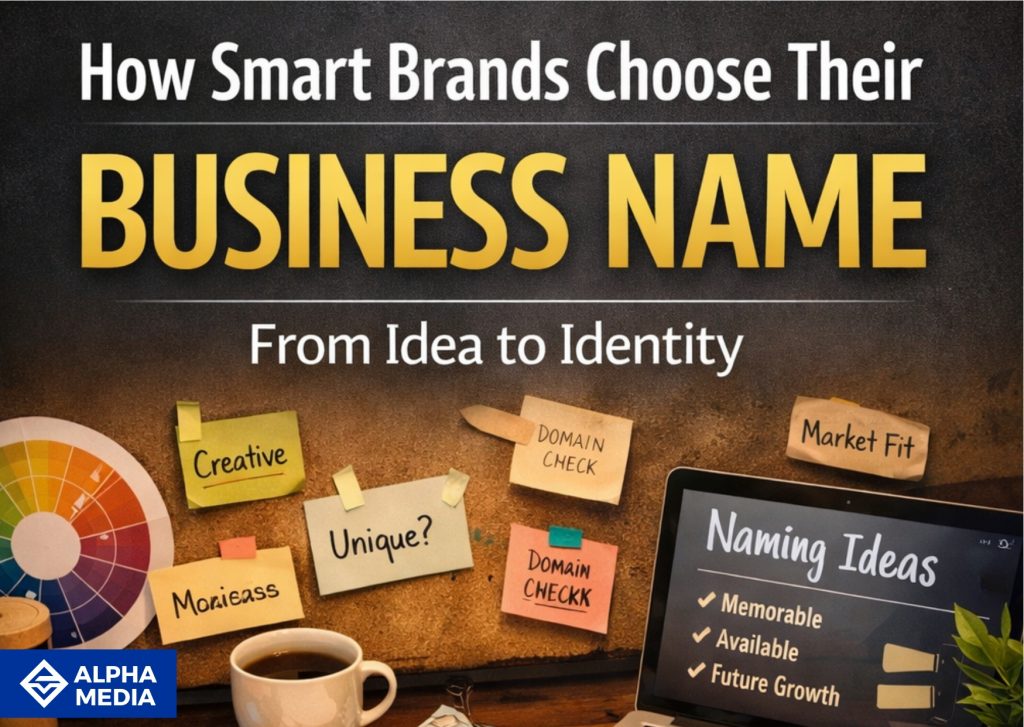
How Smart Brands Choose Their Business Name:
A Proven Framework to Pick a Name That Grows With You
Introduction
Let me ask you a question: have you ever recommended a product to a friend, but completely forgotten what it was called? Or seen a business name for the first time and immediately known you would never buy from them?
Chances are, you have. That is the quiet power of your business name.
I’ve worked with startup founders, small business owners, and enterprise teams for over 12 years, and without fail, the business naming process is one of the most stressful parts of building a company. I’ve seen founders spend 3+ months arguing over names, lose sleep over domain availability, and even abandon perfectly good business ideas because they couldn’t find “the one” the magical name that will guarantee success.
Here is the hard truth: a great business name will not save a bad product or service. But a bad name can sink your business before you ever get a chance to prove yourself.
In a world where the average person is exposed to thousands of marketing messages every day, your business name is your first impression. It is the first thing people see, the first thing they hear, and the thing they will use to find you, recommend you, and remember you.
A great name does quiet work for you every single day. It reduces friction for your customers. It differentiates you from your competitors. It saves you money on marketing. And over time, it becomes one of your most valuable intangible assets. Some of the most valuable brands in the world are worth billions of dollars, and a huge portion of that value is tied up in their name and reputation.
The good news is that you don’t need to be a marketing genius or a poet to pick a great business name. Smart brands don’t rely on luck. They follow a process. They understand the psychology behind naming. They learn from the mistakes of others. And they make decisions that align with their long-term vision, not just what sounds good today.
In this article, we’re going to cover everything you need to know to pick a business name that works. Here’s what you’ll learn:
- The most common naming mistakes that kill businesses (and how to avoid them)
- The hidden psychology of great brand names (what your name is really telling your customers)
- The 5 naming archetypes used by almost every successful brand, and which one is right for you
- A step-by-step framework you can use this week to pick your business name
- Real case studies of how famous brands chose their names (some of these stories will surprise you)
- Tools and resources to make the process easier
- And when it might be time to rebrand your existing business
By the end of this article, you’ll walk away feeling clearer, more confident, and equipped with a process to pick a name that will grow with your business for years to come.
What a Business Name Actually Is (Beyond the Obvious)
Most people think a business name is just what you put on your business license, your website header, and your business cards. Smart brands know better.
Your business name is 5 critical things all at once:
1. Your first marketing message
If someone hears your name for one second, what do they learn? A name like FedEx tells you immediately that this is a company that delivers things. A name like Patagonia tells you this company is connected to nature, adventure, and ruggedness. You don’t need to read a tagline or visit their website to get that first impression.
2. A mnemonic device
Human beings are terrible at remembering things. Your job with your business name is to make it as easy as possible for people to remember you, recommend you, and find you online. If someone has to stop and think about how to spell your name, or if they forget it 5 minutes after hearing it, you’ve already lost.
3. A legal asset
Your business name is one of the core components of your trademark. A strong, unique name is much easier to trademark and protect than a generic or descriptive name. I’ve seen small businesses get hit with expensive cease and desist letters because they picked a name that was too similar to a bigger brand. This is a completely avoidable mistake.
4. A canvas for your brand identity
Your name will be everywhere: on your logo, your website, your product packaging, your social media profiles, and your advertising. Some names work beautifully with graphic design. Others will force your design team to jump through hoops to make it look good. Short, simple names are almost always easier to turn into strong visual brands.
5. Part of your brand story
The best brand names have a story behind them. Not every customer will ask, but when they do, you have an opportunity to connect with them on a deeper level. The stories behind Starbucks, Nike, and Patagonia all help reinforce what those brands stand for.
Before you start brainstorming names, ask yourself this: what job do I need my business name to do?
Are you a local plumber that needs people to immediately understand what service you provide? Then a descriptive name might work best. Are you building a startup that might pivot and expand into new categories in the future? Then an evocative or abstract name might give you far more room to grow.
Too many founders pick a name first, and then figure out their brand strategy later. Smart brands do it the other way around.
Why Most Founders Get Business Naming Wrong
Over the years, I’ve seen the same naming mistakes destroy otherwise promising businesses. The worst part? Most of these mistakes are made because founders are listening to bad advice, or prioritizing the wrong things.
Let’s break down the 6 most common mistakes, with real examples of how they hurt businesses.
1. Prioritizing domain availability over everything else
This is the single most common mistake I see.
Founders will come up with a great name, check if the .com domain is available, and when it’s not, they abandon the name entirely. Instead, they’ll pick a second or third-rate name just because the .com is free. Or worse, they’ll add random suffixes, hyphens, or numbers to their ideal name to make it work.
For example: if your ideal name is “Green Leaf” and greenleaf.com is taken, don’t settle for green-leaf123.com or greenleafpro.io.
Here is the truth: yes, a .com domain is still ideal. But it is not the end of the world if you can’t get the exact .com.
- First, you can try to buy the domain from the current owner. Millions of domains are sitting idle, and many domain owners are willing to sell for a fair price.
- Second, you can use a subtle modifier that actually enhances your brand. Words like “get”, “try”, “join”, or “hello” work extremely well.
The worst thing you can do is pick a bad name just to get a domain. Your customers will forget your name long before they care about your domain extension.
2. Overcomplicating spelling or pronunciation
Remember what we said earlier: your name is a mnemonic device. If people can’t spell it after hearing it once, or can’t pronounce it without asking, it will cost you customers.
A famous example of this mistake is Xobni. This was a well-funded startup in the 2000s that made email management software. The name was “inbox” spelled backwards. Clever, right?
Wrong.
No one could pronounce it. No one could spell it. Investors struggled to say it in meetings. Customers couldn’t find it on Google. The company eventually folded, and while there were other factors at play, their terrible name made every single part of their business harder.
The rule of thumb here is simple: say your name out loud to someone who has never heard it before. Then ask them to spell it. If they can’t do it easily, go back to the drawing board.
3. Chasing trends that will feel dated in 5 years
Naming trends come and go.
In the late 90s, every tech company had “web”, “cyber”, or “net” in their name. In the 2010s, it was “-ly” names. Today, every AI startup is slapping “AI” in their name or using a .ai domain extension.
There is nothing wrong with this in the short term, but smart brands think long term.
What will happen in 10 years when AI is no longer a novel technology, and every company uses AI? Naming your company “AI Solutions” will be the same thing as naming your company “Computer Solutions” was in the 90s. It will be generic, forgettable, and boring.
Trendy names can work if you’re building a short-term project, but if you want to build a brand that will last for decades, avoid leaning too hard into current fads.
4. Being too descriptive, and boxing yourself in
Descriptive names can be great because they give customers instant clarity. But they come with a huge risk: they can limit your growth.
Let’s say you start a business selling handmade dog collars. You name your company “Luxury Dog Collars”. That’s great for the first year or two. But then you start getting requests for dog beds, leashes, toys, and grooming products. Now your name is a liability. Customers see your name and assume you only sell collars. You could rebrand, but that is expensive and time-consuming.
This is exactly why Jeff Bezos didn’t name his company “Online Bookstore”. Instead, he picked Amazon, a name that implied scale, and gave him the freedom to sell anything and everything. Today, Amazon sells everything from books to groceries to cloud computing services. If they had picked a descriptive name early on, they would have been forced to rebrand halfway through their journey, and they might not be the company we know today.
5. Ignoring cultural and linguistic connotations
This is an old story, but it is so important that it bears repeating.
Back in the 1960s, General Motors launched the Chevy Nova in Latin America. Sales were terrible. At first, no one could figure out why. The car was good, pricing was competitive, and marketing was solid.
Eventually, someone realized the problem. In Spanish, “no va” translates to “it doesn’t go”. Can you imagine buying a car named “It Doesn’t Go”?
GM eventually fixed the issue, but they wasted millions of dollars in marketing and lost valuable market share because no one bothered to check what their name meant in another language.
This isn’t just a problem for international brands either. Even within English-speaking countries, slang changes over time. A word that is harmless today could become an offensive slang term in 10 years. It’s hard to predict, but it is worth doing a quick check to make sure your name doesn’t have any unintended meanings.
6. Trying too hard to be unique, to the point of being meaningless
A lot of founders are under the impression that their name has to be 100% original. So they start combining random syllables to make up a word, and they end up with something that no one can remember or connect with.
Here is the thing: uniqueness is important, but so is familiarity. Human beings are wired to prefer things that feel familiar.
Abstract, made-up names can work, but only if you’re willing to spend millions of dollars on marketing to give that word meaning. Google worked because Google built so much value into the name that today, it’s not just a company name it’s a verb.
But most of us aren’t Google. Most small businesses and startups don’t have that kind of marketing budget. For the rest of us, it’s better to pick a name that people can connect with immediately, without you having to explain it to them.
The Hidden Psychology of Great Brand Names
Smart brands don’t just pick names that sound good. They pick names that work with the way human brains are wired.
You don’t need a PhD in psychology to use these principles, but understanding them will make you much better at picking a great name.
1. The fluency heuristic: easy = good
Psychologists have discovered something called the “fluency heuristic”. Basically, our brains prefer things that are easy to process.
Names that are easy to pronounce, easy to spell, and easy to remember are perceived as being safer, more trustworthy, and higher quality than names that are complicated.
One study published in the Journal of Experimental Psychology found that companies with easier to pronounce names performed better on the stock market. Another study found that people are more likely to trust brands with simple names.
This is why so many successful brands have short, simple names. Two syllables is ideal. One syllable can work too. You can get away with three syllables, but anything longer than that is going to be an uphill battle.
2. Sound symbolism: sounds send silent messages
Here is something you might not have realized: certain sounds evoke certain feelings, even without any context. This is called sound symbolism.
- Hard consonants (K, T, P, Q, G) are perceived as strong, powerful, and aggressive. These sounds work great for sports brands, power tools, and energy drinks. Examples: Nike, Caterpillar, Red Bull, Jeep.
- Soft consonants (L, M, N, V, W) are perceived as gentle, calming, and luxurious. These sounds work great for skincare brands, luxury goods, and food and beverage brands. Examples: Dove, Volvo, Louis Vuitton, Nestle.
- Front vowels (E, I) are perceived as light and small. Back vowels (O, U) are perceived as heavy and large.
This is not a hard and fast rule, but it is something to consider. If you’re building a skincare brand for sensitive skin, a name full of hard K sounds is probably not the best fit. If you’re building a sports drink brand, soft L sounds might not evoke the energy you’re going for.
3. The uniqueness paradox
Your name needs to walk a fine line.
It needs to be unique enough to stand out from your competitors, but familiar enough that people feel comfortable with it.
If your name is too generic, you’ll get lost in the crowd. If your name is too weird, people will be wary of it.
Think about it: if you saw two coffee shops next to each other, one named “Joe’s Coffee” and another named “Xyloz”, which one would you be more likely to try? Most people would pick Joe’s Coffee, because it feels familiar and safe.
The sweet spot is a name that is unique, but still grounded in something people recognize. That is why compound names like Netflix or Shopify work so well. Everyone knows what the individual words mean, but combining them into one word makes it unique.
4. People remember stories, not random words
Our brains are wired to remember stories.
If your name has a story behind it, people are far more likely to remember it and connect with your brand.
This is one of the reasons founder names work so well. When you name your brand after yourself, you’re automatically tying it to your personal story. Patagonia’s name tells a story of adventure and wild places. Nike’s name tells a story of victory.
When you’re brainstorming names, don’t just think about words. Think about stories. What is the story you want your name to tell?
The 5 Naming Archetypes Smart Brands Use
Almost every successful brand name falls into one of these 5 categories.
None of these archetypes are inherently better than the others. The right one for you depends on your industry, your target audience, your marketing budget, and your long-term goals.
Let’s break them down, one by one.
1. Descriptive Names
As the name implies, descriptive names tell your customers exactly what you do. The entire point of a descriptive name is to eliminate confusion. Someone hears the name, and they immediately know what business you’re in.
Examples: PayPal, YouTube, FedEx, Bank of America, General Motors, American Airlines.
Pros:
- Instant clarity. No explanation required.
- Great for SEO. If you name your plumbing business “Denver Plumbing Co”, you’re going to rank for that keyword without much effort.
- Low marketing cost. You don’t have to spend money teaching people what your business does.
Cons:
- Extremely hard to trademark. Generic descriptive terms are almost impossible to protect.
- You can easily box yourself in, as we discussed earlier.
- Hard to stand out. Every industry is full of descriptive names, so you’ll need to work harder to differentiate yourself.
Best for:
- Local small businesses
- Businesses that don’t plan to expand their product offerings
- B2B service businesses
Pro tip: If you choose a descriptive name, you’ll need to invest in other areas of your brand to stand out. An experienced graphic designer can help you create a unique logo and visual identity that sets you apart from all the other generic-named businesses in your industry.
2. Evocative Names
Evocative names don’t describe what you do. Instead, they evoke the feeling, benefit, or value that you provide.
This is the naming strategy used by many of the world’s most valuable brands. These names give you maximum flexibility to grow and expand into new categories.
Examples: Amazon, Nike, Patagonia, Red Bull, Tesla, Oracle.
Pros:
- Unlimited room to grow. None of these companies are limited by their name.
- Strong trademark potential. These names are unique and easy to protect.
- They give your brand personality right out of the gate.
Cons:
- You have to do more marketing work. People won’t know what you do just from hearing your name. You’ll need great copywriting and digital marketing to explain your value proposition.
- They can be harder to come up with. It takes more creativity to find a word that evokes the feeling of your brand without being too on the nose.
Best for:
- Startups and consumer brands that plan to scale
- DTC brands
- Brands that want to build a lifestyle brand
Pro tip: Evocative names pair extremely well with strong storytelling. A business strategist or copywriter can help you craft the story behind your name and weave it into all of your marketing material to build a deeper connection with your customers.
3. Compound & Portmanteau Names
This is where you combine two existing words to create a new word that is both familiar and unique.
Compound names have exploded in popularity over the last 20 years, and for good reason. They strike the perfect balance between clarity and uniqueness.
Examples: Facebook, Netflix, Shopify, Snapchat, Instagram, WordPress.
Pros:
- Easy to understand and remember. People already know the words you’re combining, so they don’t have to work hard to process your name.
- Unique without being weird.
- Good trademark potential.
- Flexible. You can expand your business as long as you stay within the general theme of your name.
Cons:
- A lot of the obvious combinations are already taken. Between domain names and trademarks, most simple compound names are already claimed.
- They can feel generic if you don’t pick the right combination.
Best for:
- Tech startups
- SaaS companies
- E-commerce brands
Pro tip: A lot of great compound names are hiding in plain sight. Instead of combining two generic words, try combining a word related to your product with a word related to the benefit it provides. Shopify does this perfectly: “shop” (what you do) + “ify” (to make or become) = make shopping easy.
4. Abstract & Made-Up Names
Abstract names are words that don’t have any meaning until you give them meaning. They can be completely made up words, or existing words that have nothing to do with your industry.
If you can pull this off, you’ll have a name that is uniquely yours, and extremely easy to trademark. But this strategy requires the most marketing investment.
Examples: Google, Kodak, Xerox, Spotify, Rolex, Sony.
Pros:
- Best possible trademark protection. These names are almost impossible to confuse with any other brand.
- Total flexibility. You can take your business anywhere without your name holding you back.
- They can feel modern and premium.
Cons:
- Extremely expensive to build brand recognition. You have to spend millions of dollars to make people associate your made-up word with your business.
- Customers will have no idea what you do from your name alone. You’ll need to invest heavily in digital marketing and copywriting to educate your market.
- It’s easy to make a name that is unpronounceable or unmemorable.
Best for:
- Large companies with big marketing budgets
- Luxury brands
- Companies that are creating an entirely new category
Pro tip: If you’re a small business or startup, I generally don’t recommend this naming strategy unless you have a unique made-up word that is easy to say, easy to spell, and rolls off the tongue. Most small businesses simply don’t have the marketing budget to give an abstract name meaning over time.
5. Founder Names
This is one of the oldest naming strategies in the book. Name your business after yourself, or after one of your founders.
Examples: Ford, Disney, Chanel, Hewlett-Packard, Johnson & Johnson.
Pros:
- Simple and timeless. Founder names never go out of style.
- Great for personal brands. If you are the face of your business, naming it after yourself can build trust and authenticity.
- Good trademark potential.
Cons:
- It can be hard to sell the business later on. Buyers often don’t want to run a business named after someone else.
- It puts a lot of pressure on the founder. Any controversy involving the founder will reflect directly on the brand.
- They don’t tell you anything about what the business does.
Best for:
- Professional services firms (law firms, consulting firms, medical practices)
- Luxury brands
- Personal brands
- Family owned businesses
Pro tip: If you name your business after yourself, you can always add a descriptive tagline to give people more context. For example, “Smith & Associates: Business Tax Specialists”. or contact Alpha Media to help you craft a tagline that perfectly complements your founder name.
The 7 Step Process Smart Brands Use to Pick Their Business Name
Now we’ve arrived at the core framework. This is the exact process I’ve walked my clients through for years. It works for solo entrepreneurs, small businesses, and startups alike.
Step 1: Get clear on your brand strategy first
Before you type a single name into a domain checker, you need to get clear on the fundamentals.
If you don’t know who you are as a brand, you can’t possibly pick a good name.
Here’s what you need to figure out first:
- Who is your ideal customer? What do they care about? What words do they use to describe their problems?
- What is your brand personality? Are you playful? Professional? Luxurious? Rugged? Reliable?
- What problem are you solving for your customers?
- What is your long term vision? Do you see yourself selling the same product 10 years from now, or do you plan to expand into new categories?
If you’re struggling to answer these questions, you don’t need to figure it out alone. A business strategist or brand agency can help you work through this process and build a solid foundation before you start brainstorming names. This is one of the best investments you can make in your business early on.
Step 2: Brainstorm without filtering
Now it’s time to generate as many ideas as possible.
The goal here is quantity over quality. Don’t worry about whether an idea is good or bad. Just write it down.
Here are some ways to generate ideas:
- Word association: Write down every word you can think of related to your product, your customer, the problem you solve, the benefit you provide, and the feeling you want to evoke.
- Metaphors and mythology: A lot of great brand names come from mythology, nature, history, and literature. Nike, Amazon, and Starbucks are all examples of this.
- Compound words: Mix and match words from your list to make compound words and portmanteaus.
- Foreign words: Look for words in other languages that have the meaning you’re looking for. Just make sure you triple check for unintended connotations!
- Use tools: AI tools like ChatGPT and Claude are great for brainstorming. You can feed it your brand strategy and ask it to generate name ideas based on different archetypes. Name generator tools can also be a good source of inspiration, but don’t just take whatever they give you. Treat them as a jumping off point, not a final answer.
Pro tip: Set a timer for 30 minutes and see how many ideas you can come up with. Aim for 100+ names. Yes, most of them will be terrible. But buried in that list, you will find some gems.
Step 3: Narrow down your list
Now that you have your big list, it’s time to start cutting.
Go through your list and eliminate any name that fails any of these tests:
- Can you say it out loud easily?
- Can someone spell it after hearing it once?
- Does it fit your brand personality?
- Does it give you room to grow, or will it box you in?
- Are there any obvious unintended meanings or cultural red flags?
By the end of this step, you should have between 15 and 20 names left.
Step 4: Check for availability
This is the step everyone wants to jump to first, but trust me, doing it earlier is a waste of time. There’s no point in falling in love with a name only to find out it’s already trademarked.
There are 3 types of availability you need to check:
- Trademarks: This is the most important one.
In the US, you can do a free search on the USPTO website. Internationally, you can use the WIPO Global Brand Database. For more comprehensive searches, or if you want to make sure you’re protected, you can use a service like Trademarkia, or consult a trademark attorney.
I cannot stress this enough: getting this wrong can cost you tens of thousands of dollars and force you to rebrand later. It’s worth spending the time and money to get this right.
Domain names:
Check if your preferred domain name is available. As we talked about earlier, .com is ideal, but don’t be afraid to consider other TLDs like .co, .io, .app, or .org if they make sense for your business. If the domain is taken, you can use a domain broker service to see if the owner is willing to sell.Social media handles:
Check to see if the username is available on all the major social media platforms: Instagram, X, TikTok, Facebook, LinkedIn, and YouTube.
The good news is you don’t have to check these one by one. Tools like Namechk or Knowem will check hundreds of platforms at once for you. These are incredibly useful tools and will save you hours of time.
After this step, you might be down to 5-10 names.
Step 5: Test your names with real people
Now it’s time to get outside feedback.
The worst people to ask are your friends and family. They love you, and they don’t want to hurt your feelings, so they’ll tell you whatever you want to hear.
Instead, you want to ask people who are in your target audience.
Here are some questions to ask them:
- First impression: What do you think this business does, just based on the name?
- Does this name make you want to learn more?
- How does this name make you feel?
- Can you spell this name for me?
- I’m going to step away for 10 minutes and come back. Will you remember this name?
If you don’t have easy access to your target audience, there are other ways to get feedback. You can post in niche Reddit or Facebook groups (just make sure you follow their rules). You can use user testing tools like UserTesting.com to get feedback from real people. Or you can run a simple poll on your existing social media following if you have one.
Step 6: Sleep on it
Impatience kills good naming decisions.
I’ve seen so many founders pick a name in a hurry, only to regret it a month later.
Once you have your shortlist of 2-3 names, live with them for a while.
- Say them out loud every day.
- Picture them on your logo, your website, and your product packaging. A graphic designer can even draft up quick mockups of potential logos to help you visualize what it would look like.
- See how it feels to say “Hi, I’m [your name] from [business name]”.
- Imagine yourself still using this name 10 years from now.
Does it still feel right?
If not, keep looking.
Step 7: Make your decision, and commit
There is no such thing as a perfect business name.
At a certain point, you have to pick a name and start building value into it.
Remember, Google was a misspelling. Jeff Bezos almost named his company Cadabra. Starbucks was almost named Pequod.
None of these names are perfect. But they became great brands because the companies behind them delivered great products and services, and built meaning into their names over time.
Once you pick your name, own it. Build your website, design your logo, create your social media profiles, and start telling your story. With time, your name will come to mean everything you want it to.
Case Studies: How Famous Brands Chose Their Names
Sometimes the best way to learn is to see how the world’s most successful brands made their naming decisions.
1. Amazon
Jeff Bezos originally wanted to name his new online bookstore “Cadabra”, as in “abracadabra”. His lawyer talked him out of it. Why? Because people kept mishearing it as “cadaver”.
Bezos’s next priority was to pick a name that started with the letter A, so it would show up at the top of alphabetical lists (this was back in the early days of the internet, before search engines were good). He was looking for a name that conveyed scale. He wanted his business to be the biggest in the world. So he settled on Amazon, named after the largest river in the world.
2. Nike
Nike didn’t start out as Nike.
The company was founded in 1964 by Phil Knight and Bill Bowerman, and their original name was Blue Ribbon Sports. They imported running shoes from Japan and sold them out of the trunk of Phil Knight’s car at track meets.
By 1971, they decided to launch their own line of shoes, and they needed a new name. They considered names like Dimension 6 and Falcon. The name Nike was suggested by Jeff Johnson, their first ever employee. Nike is the name of the Greek goddess of victory.
3. Starbucks
The founders of Starbucks originally wanted to name their coffee company Pequod, which is the name of the ship in Moby Dick.
Thankfully, they came to their senses. They decided instead to name it after Starbuck, the first mate of the Pequod. The name fit perfectly with their original vision of evoking the seafaring tradition of the early coffee traders.
4. Shopify
Shopify has one of the most perfect compound names in modern business. But it wasn’t their first choice.
Shopify founder Tobi Lütke originally started the company to sell snowboarding equipment. His original business name was Snowdevil.
After building his own software to power his online store, he realized that the software was more valuable than the snowboards. He pivoted his business and started selling the e-commerce software to other businesses.
Snowdevil obviously didn’t work for his new business. So he started brainstorming. He combined “shop” with the suffix “ify”, which means “to make or become”. Shopify: to make shopping easy.
5. Patagonia
Patagonia founder Yvon Chouinard started his company selling rock climbing gear out of his garage. His original company name was Chouinard Equipment.
As the company grew, they started expanding into other outdoor gear: camping equipment, hiking gear, ski gear, and apparel. Chouinard Equipment was too tied to its founder, and didn’t fit the company’s new identity.
Yvon Chouinard loved Patagonia, the remote and rugged region at the southern tip of South America. The name evokes wilderness, adventure, and natural beauty. It’s the perfect name for a brand that is built around outdoor adventure and environmental stewardship.
When Should You Rebrand and Change Your Business Name?
What if you already have an established business, and you’re wondering if you should change your name?
Smart brands don’t fall in love with their names. They are willing to rebrand if it’s the right decision for their future.
Here are 5 signs that it might be time to change your business name:
- Your name is holding you back from growth. If you’ve expanded your product or service offerings and your current name no longer fits.
- You have an unavoidable trademark issue. If you’ve received a cease and desist letter, you might not have any other choice.
- Your name has negative connotations. Sometimes language changes, or external events give your name a negative meaning that you can’t escape.
- You’ve pivoted your business model. Like Shopify, if you completely change what your business does, your old name might not make sense anymore.
- Your name is generic or hard to remember. If you’ve been in business for a few years and you’re still having to spell your name for people, or customers are constantly confusing you with another business, a rebrand could help.
Rebranding is a big project. It will require updating your logo and visual identity (graphic design), rebuilding or updating your website (web development), rewriting your brand messaging (copywriting), and launching a digital marketing campaign to let your existing customers know about the change.
If you decide to go down this path, Alpha Media is here to help you rebrand your business we are an experienced brand agency that can make the process much smoother, we’ll help you navigate all the moving parts and make sure you don’t lose any of your existing brand equity in the process.
Subtle Monetization Opportunities
All of the recommendations below are tools and services that I would recommend to any founder going through this process, regardless of affiliate commissions. They all solve real problems and make the naming process far easier.
Tools and Resources
Namechk / Knowem
These tools let you check the availability of your desired name across hundreds of domain extensions and social media platforms in seconds. This will save you hours of manual work. Both platforms offer affiliate programs.Trademarkia
An easy-to-use trademark search tool that lets you check for existing trademarks in the US and internationally. If you don’t want to hire an attorney right away, this is a great first step to de-risk your name choice.GoDaddy Auctions / Namecheap Marketplace
If your perfect domain name is already taken, these marketplaces let you make an offer to the current owner. Millions of domains are registered but unused, and you might be able to pick up your ideal domain for a reasonable price.UserTesting.com
If you want to get honest feedback on your name ideas from real people in your target audience, this is one of the best user testing tools available.AI Brainstorming Tools
ChatGPT, Claude, or Jasper can all be great for generating initial name ideas and exploring different angles. Just make sure you use them as a starting point, not a final decision maker.
Professional Services
Building a great brand is hard work, and there is no shame in asking for help. If you don’t have the time, creativity, or expertise to handle this process on your own, these are the services that can help:
- If you need help getting clear on your brand identity before naming your business: a business strategist or brand agency.
- If you need help crafting the story behind your name or writing a strong tagline: a copywriter.
- Once you pick your name, you’ll need to bring it to life visually: a graphic designer to create your logo and brand assets.
- To build your online home: a web developer to help you secure your domain, set up hosting, and build a website that showcases your new brand.
- If you’re rebranding or launching a new name: a digital marketing expert to help you plan and execute a launch campaign to inform your customers.
Conclusion
Picking a business name is one of the first big decisions you will make as an entrepreneur.
It’s easy to overthink it. It’s easy to get paralyzed looking for a name that doesn’t actually exist: the perfect name that will solve all your business problems.
But what I hope you take away from this article is that the best business names aren’t the cleverest ones, or the most unique ones.
They are the names that align with your long term vision, resonate with your target customers, are easy to remember and spell, and give you room to grow.
Your name is the starting line, not the finish line.
Over time, as you deliver great products and services, as you connect with your customers, and as you tell your story, your name will come to represent all of that value. The name itself doesn’t make the brand. You and the work you do do.
The most important thing you can do is pick a name that checks the important boxes, commit to it, and then go build a great business.
What do you think is the biggest challenge related to choosing a business name, and how do you think individuals or businesses can overcome it?